

Chengdu Wanjiang Tower Park
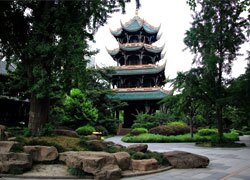 Wangjiang Tower Park was built to honor Xue Tao, a well-respected poet during the Tang Dynasty who wrote over 500 poems. Because of her love for bamboo, the tower park was created using 150 kinds of bamboo from different places in China and some were imported from other countries. The park is next to the bank of Jinjiang River in Chengdu and covers 30 acres of land. It is considered as an oasis of calm in the center of frantic metropolis.
Attractions
One of the major attractions in the park is the Chongli Pavilion which towers 100 ft. Therefore it serves as the focal point of the whole park. Standing by the side of the Jingjiang River, it is surrounded by nature and one of Chengdu symbols. The four-story pavilion was constructed during the Qing Dynasty. It features octagonal and square upturned eave on each story. It was made using glazed tiles, vermillion columns, and gilt cupola.
Another attraction is the Yinshi Building. This was built to replicate the building where Xue Tao lived in. Xue Tao loved spacious rooms, bamboo groves, and river. The setting is definitely perfect for writing poems.
Visitors shouldn’t miss the group of memorial buildings with paintings, calligraphy, poems, and other art forms. The buildings that feature Sichuan-style garden are Wuyunxian Hall, Pipa Alley, Quanxiang Pavilion, Qingwa House, and Huanjian Pavilion.
In the park, one can easily find a well which is believed to have been the place where Xue Tao got the water for her writing paper which made her paper colorful but delicate. There’s also the white marble statue of the poet which is known to be the poetry in stone. Visitors are encouraged to enjoy tea made from water well, read poems, or simply get fascinated with great surrounding and relaxing atmosphere.
Lastly, one shouldn’t miss the relaxing bamboo grove. Hundreds of bamboos capture your attention the moment you enter the park, which offers good opportunity. It’s also great for visitors wanting to walk around and rest.
Useful Information
Address: South bank of the Jinjiang River, No. 300, Wangjiang Road, Wuhou District(near the East Gate of Sichuan University)
Entrance Admission: free
Admission to cultural preservation area: CNY20/person
Hours: 6am-9pm
Phone number: 028-8522-3389
Getting there: Take bus 3, 19, 35, and 335